



7 Signs You’ve Outgrown Sales Commission Spreadsheets
Still calculating commissions in spreadsheets? Discover seven warning signs your sales compensation process needs automation.
 Amy Cook·6 min read

83% Still Use Spreadsheets for Sales Commissions. Here Are 7 Signs It’s Time to Stop.
Your sales team has AI-powered prospecting, automated CRM workflows, and software that can predict which deals are most likely to close.
But when it’s time to calculate commissions?
Someone opens Excel.
According to Forma.ai’s 2026 Sales Compensation Administration Efficiency Report, 83% of surveyed compensation leaders still use spreadsheets to manage sales compensation. Even among respondents using dedicated compensation platforms, 81% also rely on spreadsheets.
Apparently, Excel didn’t get the memo about the AI revolution.
Spreadsheets aren’t inherently bad. They’re flexible, familiar, and perfectly capable of calculating a straightforward commission. But when compensation plans become more complex, the spreadsheet that once saved time can become the reason everyone is working late.
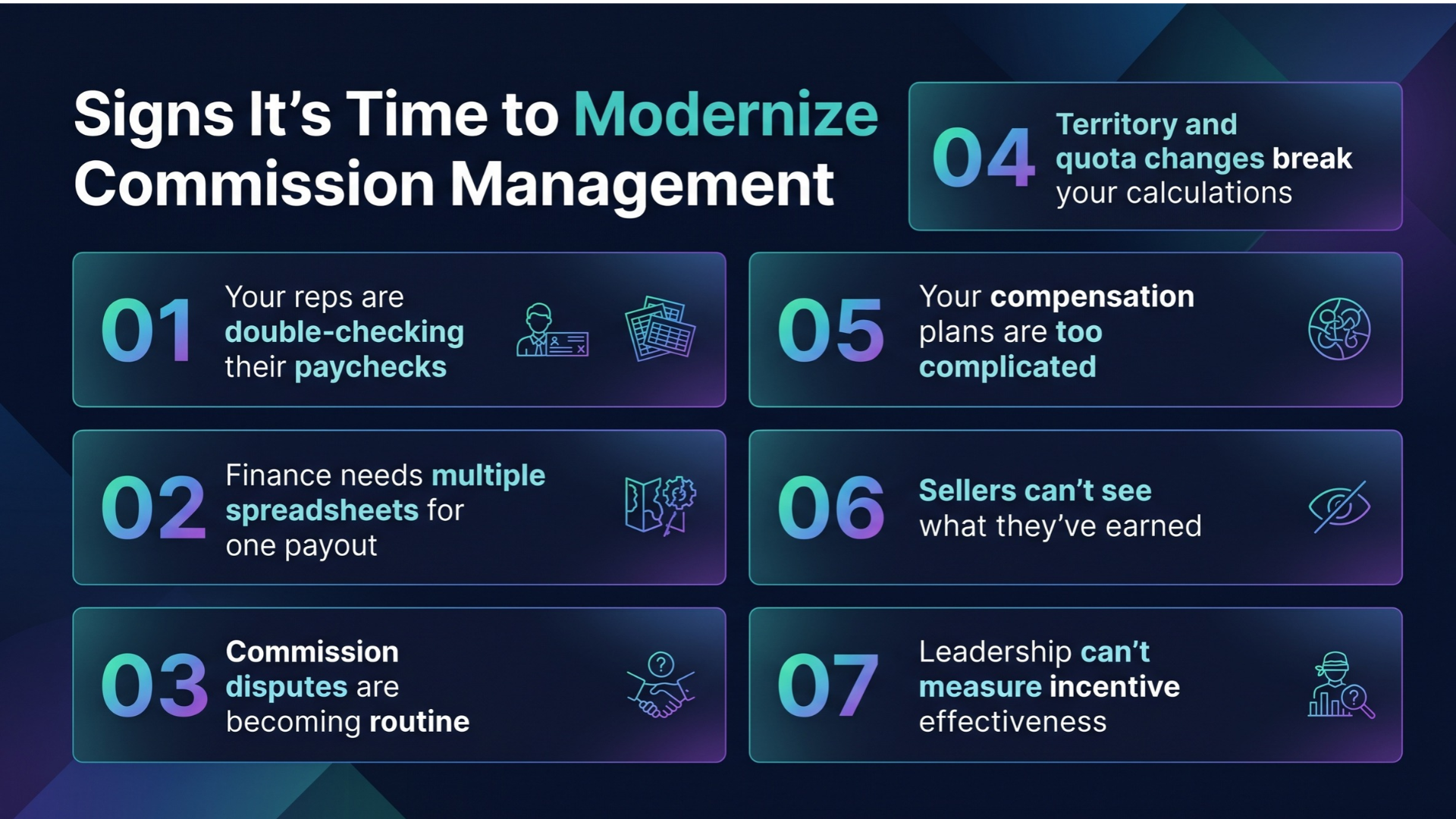
Here are seven signs your commission process may have outgrown it.
1. Your Sales Reps Are Double-Checking Their Paychecks
Salespeople should understand how much they’ve earned. They shouldn’t need to become part-time accountants to figure it out.
Forma.ai’s 2026 research found that 34% of surveyed compensation leaders estimated their sellers spend at least five hours per month independently checking compensation. That’s a significant amount of time spent verifying something the business should already understand.
- The warning sign: Representatives maintain their own spreadsheets because they don’t fully trust or understand the official calculations.
- What to do: Give sellers clearer visibility into commission calculations, attainment, and payout status. Transparency can reduce confusion before it becomes a dispute.
2. Finance Needs Multiple Spreadsheets to Calculate One Payout
A sales representative closes a deal. Simple enough. Except the commission depends on the product sold, territory assignment, quota attainment, contract terms, and whether another representative helped close it.
Now finance needs information from three departments and four spreadsheets. The calculation itself might be straightforward. Finding the correct information is another matter.
- The warning sign: Commission processing requires repeated data exports, manual reconciliation, and copying information between files.
- What to do: Standardize compensation data and connect the systems involved in calculating payouts. Automation is most useful when it eliminates repetitive handoffs.
3. Commission Disputes Have Become a Monthly Tradition
Commission disputes can happen for legitimate reasons, even with sophisticated software. But repeated disputes may indicate unclear rules, inconsistent data, or limited visibility. And every dispute requires someone to investigate. That means sales managers, finance teams, and representatives spend time reconstructing calculations instead of focusing on revenue.
- The warning sign: The same payout questions appear month after month, and resolving them requires digging through historical spreadsheets.
- What to do: Document compensation rules, maintain an audit trail, and establish a consistent dispute-resolution process.
4. Territory and Quota Changes Break Your Calculations
Revenue organizations change constantly. Unfortunately, compensation spreadsheets don’t always appreciate surprises. A formula designed for January’s sales organization may not reflect the business in June. And when compensation rules are scattered across multiple files, even a small change can require extensive manual updates.
- The warning sign: Every organizational adjustment creates a new round of spreadsheet modifications and calculation checks.
- What to do: Centralize compensation rules and document effective dates so changes can be managed consistently.
5. Your Compensation Plans Are Getting Too Complicated to Manage Manually
Accelerators. Splits. Overlays. Bonuses. Clawbacks. SPIFs. Each incentive can serve a legitimate business purpose. Together, they can create a compensation calculation that looks suspiciously like a graduate-level math exam. The problem isn’t complexity by itself. It’s whether the organization can administer that complexity accurately and explain it clearly.
- The warning sign: Only one or two people understand how the commission spreadsheets actually work.
- What to do: Standardize plan documentation and evaluate whether commission management software can support the rules without relying on fragile manual calculations.
6. Nobody Can Explain Exactly How Much a Rep Has Earned
Imagine asking a salesperson how close they are to their next commission accelerator. Now imagine the answer is, “I’ll know when finance sends the report.”
That’s not ideal.
Compensation plans are supposed to motivate performance. But incentives lose some of their usefulness when sellers can’t see how their actions affect earnings.
- The warning sign: Representatives have limited visibility into attainment, expected commissions, or the rules affecting their payouts.
- What to do: Provide accessible commission statements and clear explanations of how earnings are calculated.
7. Leadership Can’t Tell Whether the Compensation Plan Is Working
Commission management isn’t simply about paying people correctly. It’s also about encouraging the sales behaviors that support business strategy. Yet Forma.ai’s 2026 research found that 55% of surveyed compensation leaders either don’t regularly evaluate plan effectiveness or only evaluate it during plan design.
That’s a problem when market conditions, sales priorities, and customer behavior keep changing. A company might be paying commissions accurately while rewarding activities that no longer support its growth objectives.
- The warning sign: Leadership can calculate what commissions cost but struggles to explain whether those incentives are improving performance.
- What to do: Review attainment, payout distribution, incentive effectiveness, and alignment with business goals throughout the year.
When Is It Time to Replace Sales Commission Spreadsheets?
Companies should consider sales commission automation when manual calculations, recurring disputes, complex incentive rules, or disconnected data make compensation difficult to manage accurately and consistently. The decision should depend on operational complexity and reliability, not simply company size.
Here’s a quick self-assessment:
| If your organization… | Consider prioritizing… |
|---|---|
| Frequently reconciles multiple spreadsheets | Data integration |
| Experiences recurring payout disputes | Calculation transparency and audit trails |
| Manages complex commission structures | Rules-based commission automation |
| Struggles with organizational changes | Centralized plan administration |
| Has limited seller earnings visibility | Commission dashboards |
| Rarely evaluates incentive effectiveness | Compensation analytics |
A small company with simple compensation rules may be perfectly comfortable using spreadsheets. Whereas a larger organization managing multiple plans, territories, currencies, and incentive structures may need something more robust. The goal isn’t to eliminate spreadsheets simply because they’re old technology. It’s to recognize when they’ve become an obstacle to accuracy, efficiency, and growth.
What Should You Look for in Sales Commission Automation Software?
Before selecting a platform, evaluate whether it can support your actual compensation requirements.
Important capabilities may include:
- Flexible commission rules for different plans and incentives
- Integration with relevant CRM and financial data
- Support for splits, accelerators, bonuses, and adjustments
- Transparent commission reporting for sales representatives
- Approval workflows and calculation audit trails
- Reporting that helps leadership evaluate compensation effectiveness
Fullcast Pay can help organizations move beyond fragmented manual commission administration and manage compensation through a more structured system. But software alone won’t fix unclear incentive plans or unreliable source data. Those problems need attention too.
The Spreadsheet Isn’t the Villain. The Process Might Be.
Spreadsheets have supported sales compensation for decades, and they’re not going anywhere.
Nor should they.
But there’s a difference between using Excel as a helpful analytical tool and depending on it to hold together an increasingly complicated compensation operation.
If your salespeople are checking their own payouts, finance is reconciling multiple files, and leadership can’t measure whether incentives are working, the organization may have outgrown its process. And with companies investing heavily in AI and automation, commission management deserves a closer look.
The real goal isn’t to calculate commissions faster. It’s to make compensation accurate, transparent, adaptable, and aligned with revenue performance.
Ready to simplify your sales commission process? Explore how Fullcast Pay can help you manage compensation with greater consistency and visibility.